
Nine out of ten startups fail—but what counts as a failure isn’t always clear. For Grafren, the journey has been less about sticking to an idea and more about daring to change it time and time again. This past summer, the company was kicked out of LEAD—a traditional rite of passage—and is now ready for the next chapter.
When the startup Grafren joined LEAD, the founders had a promising technology but no fully developed business model. Today, they are developing advanced materials for defense-related applications and have left the incubator to move on to the next phase of growth. The journey to this point has been marked by repeated reevaluations and an approach in which ideas are constantly tested, adjusted, and sometimes abandoned entirely.
Erik Khranovskyy, CEO and co-founder, believes that the perception of failure in the startup world is often oversimplified.
“I think people are looking at it the wrong way. It’s not the startup that fails—it’s the idea. To succeed, you have to be prepared to change it. We’ve done that many times along the way—probably a hundred times,” he says.
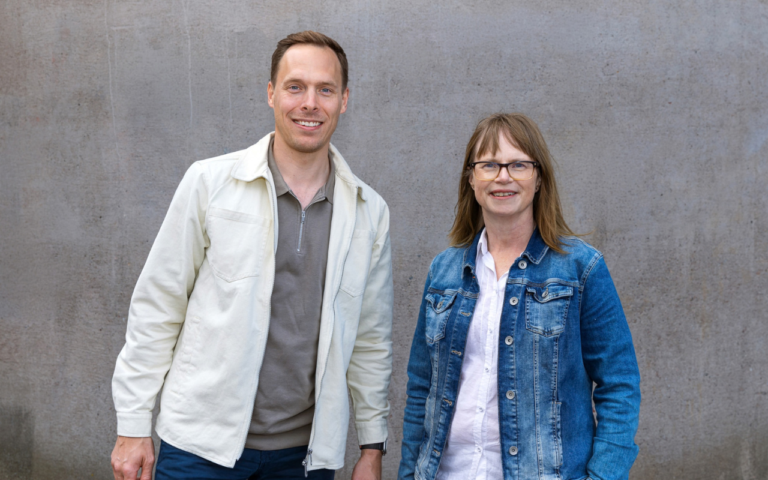
Behind Grafren are Erik Khranovskyy and Mykhailo Zhybak, both engineers with backgrounds in graphene research at Linköping University.
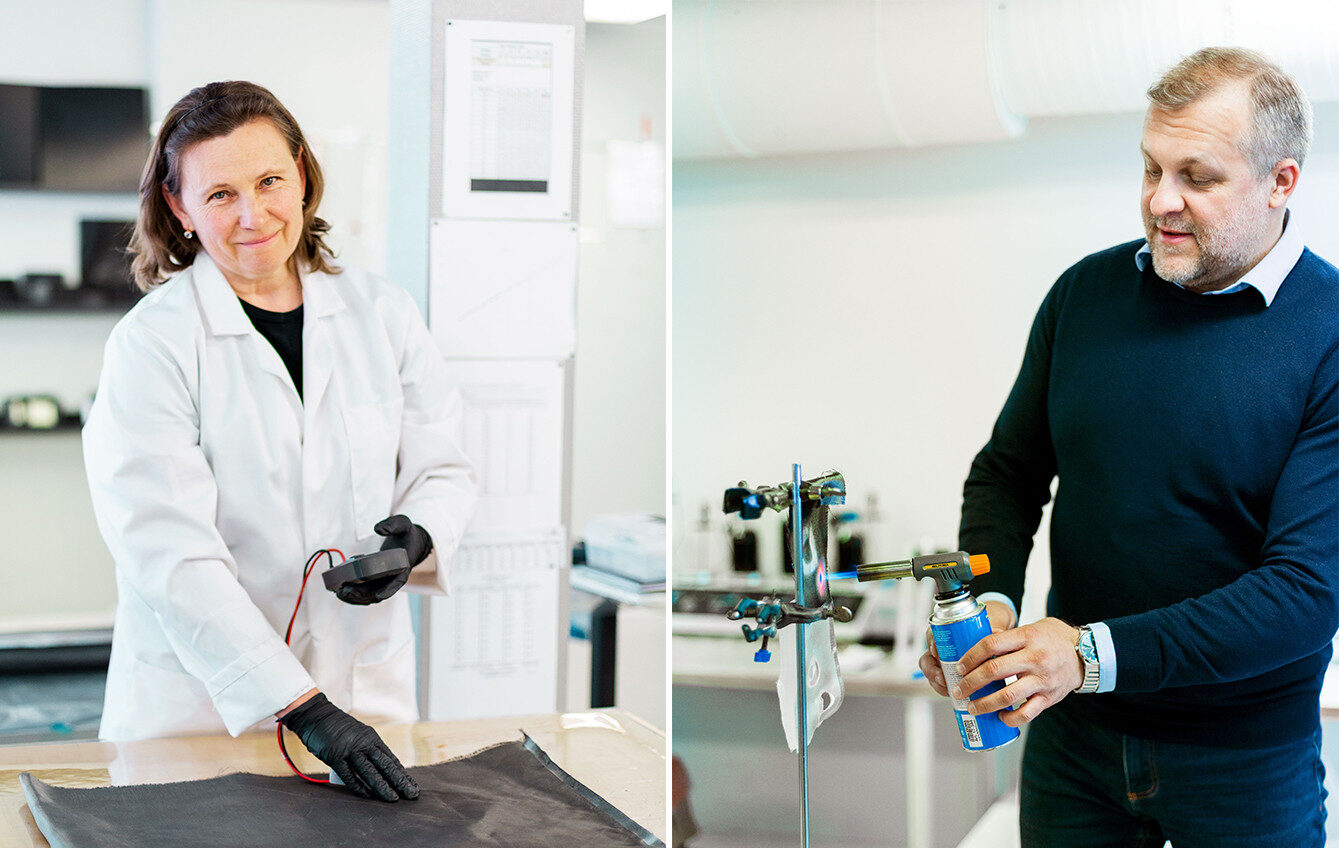
Their research led to the development of a patented chemical process that makes it possible to produce a graphene powder that can be mixed with water. The result is a kind of “ink” that can be applied to textiles and other materials, giving them new electrical and protective properties.
From Research to Business
In connection with the patent, they came into contact with LEAD and participated in the BootUp business development program. That’s where the transition from research to business began, but it would take several years before the business found its more stable form. During its time in the incubator, Grafren worked simultaneously on developing its technology, market, and organization.
Today, the company has four full-time employees, a couple of part-time employees, and an office in downtown Linköping. In recent years, their technology has attracted interest, particularly in the defense sector, as reported by Breakit, among others. At the same time, the company sees more potential applications in the future.
“Everything from electronic solutions in the automotive industry to radiation protection for astronauts in space could become relevant in the long run,” says Erik Khranovskyy.
When Research Meets the Market
For Erik, the transition from academia to entrepreneurship was a gradual one. The difference between developing a viable technology and building a commercial company only became clear when it was time to bring the technology to market.
– As a researcher, it’s easy to feel that 90 percent of the work is done once the technology works. But in reality, you’ve only just begun the journey. It’s only when someone is willing to pay for the solution that you actually have a business.
Support from LEAD
During his time at LEAD, Grafren has worked closely with several business coaches. Erik says that this outside perspective has been an important part of the company’s development.
– As an entrepreneur, it’s easy to get caught up in the momentum. That’s why it’s invaluable to have people around you who ask the right questions, challenge your thinking, and help you see both opportunities and risks.
“The sense of community with other entrepreneurs has also meant a lot,” he says.
– LEAD isn’t just a business incubator; this is where you build companies. Being part of a community where others are grappling with similar challenges has been incredibly valuable.
Over time, attitudes toward pace have also changed. Whereas there used to be a strong desire for faster development, a more accepting view of uncertainty has emerged.
– For a long time, I wished things would move faster. But over time, I’ve come to realize that uncertainty and stress are a natural part of life as an entrepreneur. You learn to deal with them and use them as a driving force.
Next Step
In June, Grafren left the incubator and received LEAD’s Golden Shoe —an award that signifies a company’s readiness for the next phase. The focus moving forward is on continued growth, attracting more customers, and building an organization that can stand on its own, independent of its founders.
– We’ve shifted our focus from building the business to building the organization. The goal is to create a company that isn’t dependent on any one person, but can continue to grow in a sustainable way.
Erik has some clear advice for entrepreneurs who have just begun their journey in LEAD.
– If you don’t know where you’re going, you’ll never get there. Set clear goals—both for your business and for your life—and make sure they’re aligned. And take advantage of the LEAD community—there’s a lot to learn from the people around you—but never forget why you’re there.
Pictured: Erik Khranovskyy and his lab partner, Iryna Kravchuck. Photo: Lisa Öberg