
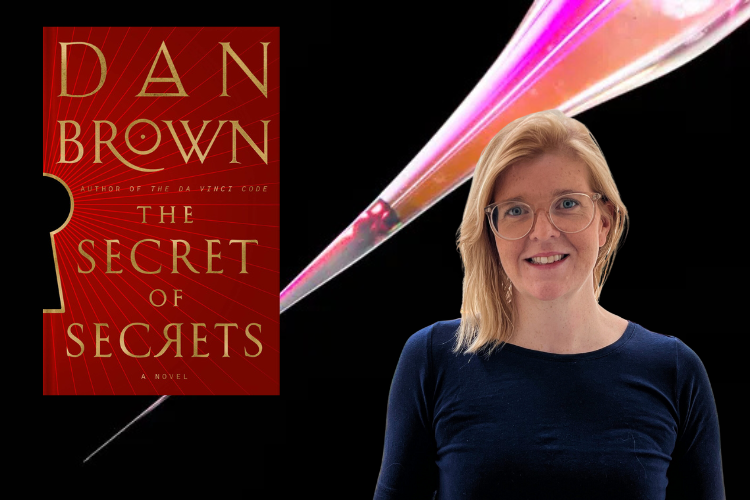
In his latest book, The Secret of Secrets, Dan Brown tackles questions about consciousness and artificial intelligence, citing research from the Laboratory of Organic Electronics (LOE) at Linköping University – where LEAD companies Iontronics and Westra have their roots. We asked Theresia Arbring Sjöström, Associate Professor at LOE and incoming CEO of Iontronics, how it feels to have your research recognized by one of the world’s most widely read authors.
How do you feel, Theresia – that Iontronic’s research is mentioned in Dan Brown’s latest book?
– Incredibly funny! We have been working on materials for ionic interaction with biological systems for many years, and for us it seems obvious. The fact that it is now highlighted in such a large cultural context shows that interest in the area is growing. It is inspiring to see that the ideas we are working on are starting to reach beyond the research world.
What is it really about?
– In The Secret of Secrets, Dan Brown explores the boundary between human consciousness and artificial intelligence. The story uses research from our research group on conducting polymers and ion modulation, as examples of how biological and electronic systems can be linked. Brown also explores the idea that similar materials could be used to connect to a universal consciousness. Very fascinating, but far from what we are working towards.
What is technology all about for you?
– With our materials and tools, we can control the release of both neurotransmitters and drugs, with high precision. We are now developing tools that can use this to restore or replace lost functions to help patients with diseases such as Parkinson’s and epilepsy in the future. We are also investigating how the same technology can inhibit tumor growth.
What questions does this raise for the future?
– All technology needs to be developed and used with care, and Brows’ book certainly raises questions about privacy. For us, prioritizing ethics, transparency and clinical relevance is crucial. We work closely with both doctors and other researchers to ensure that developments are carried out as safely and responsibly as possible.
What do you hope will happen now?
– I hope more people will be curious! The more people who engage in this type of cross-border research, the faster we can develop solutions that make a real difference for patients. There is enormous potential in understanding, amplifying and repairing the brain’s own signaling systems.